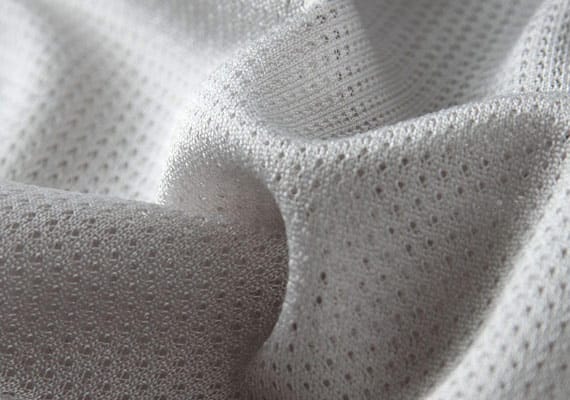
Swimwear fabric faces three enemies at once: chlorine, salt and sun. Fibre and knit selection starts there.
Swimwear and Beachwear
Weight window80–300 g/m²
CertificatesOEKO-TEX® · ISO
IncotermsEXW · FOB · DAP
Polyester ages more slowly than polyamide in chlorinated pools, locks its colour inside the fibre with disperse dyes, and gives the sharpest sublimation prints. Elastane adds the stretch — the critical balance is the elastane share and how well it is covered against chlorine fatigue.
The layer architecture is a trio: elastane structures in the outer fabric, breathable mesh in the lining, power net in the support layer. The five structures below cover that trio.
Recommended fabrics
01
Power Net (Elastane Raschel)
Power net (elastane warp knit)
150–240 g/m²
In this application
The support and shaping layer: the elastic skeleton of swimwear, foundations and shapewear.
Composition
Polyester-based: ~72–82% polyester / 18–28% elastane (spandex); the elastane ratio is tuned to the support level.
The link pre-fills the quote form with the fabrics on this page.
Frequently asked questions
Which fibre lasts longer in pool swimwear?
In chlorinated water polyester keeps its strength and colour longer than polyamide; the sensitive link is elastane. For chlorine-heavy use, a polyester ground with a balanced elastane share is the preferred build.
Why does swimwear need a lining?
The lining provides opacity, hygiene and shape support; breathable mesh in the 80–130 g/m² window drains water instead of holding it and dries fast. Where support is needed, a power-net layer is added.
How is UV protection raised in beachwear?
UPF is set by pore structure, thickness and colour: tight knitting and saturated or dark colours cut UV transmission. Since wetness can raise transmission, the target UPF is tested both dry and wet.
Alongside strictly necessary cookies, we use functional and analytics cookies only with your consent. You can choose your preferences and change them any time. Cookie Policy
Cookie preferences
Manage each category separately. Strictly necessary cookies are required for the site to work and cannot be turned off.
NecessaryAlways on
Required for the site’s core functions, security and remembering your cookie preference — including form security (hCaptcha). No consent required.
Functional
Displays embedded content such as Google Maps. When off, the map does not load until you click “Show map”.
Analytics
Helps us improve the site by measuring visit statistics. Currently inactive; when enabled it runs only with your consent.